
Clinics bring specialized care to the community
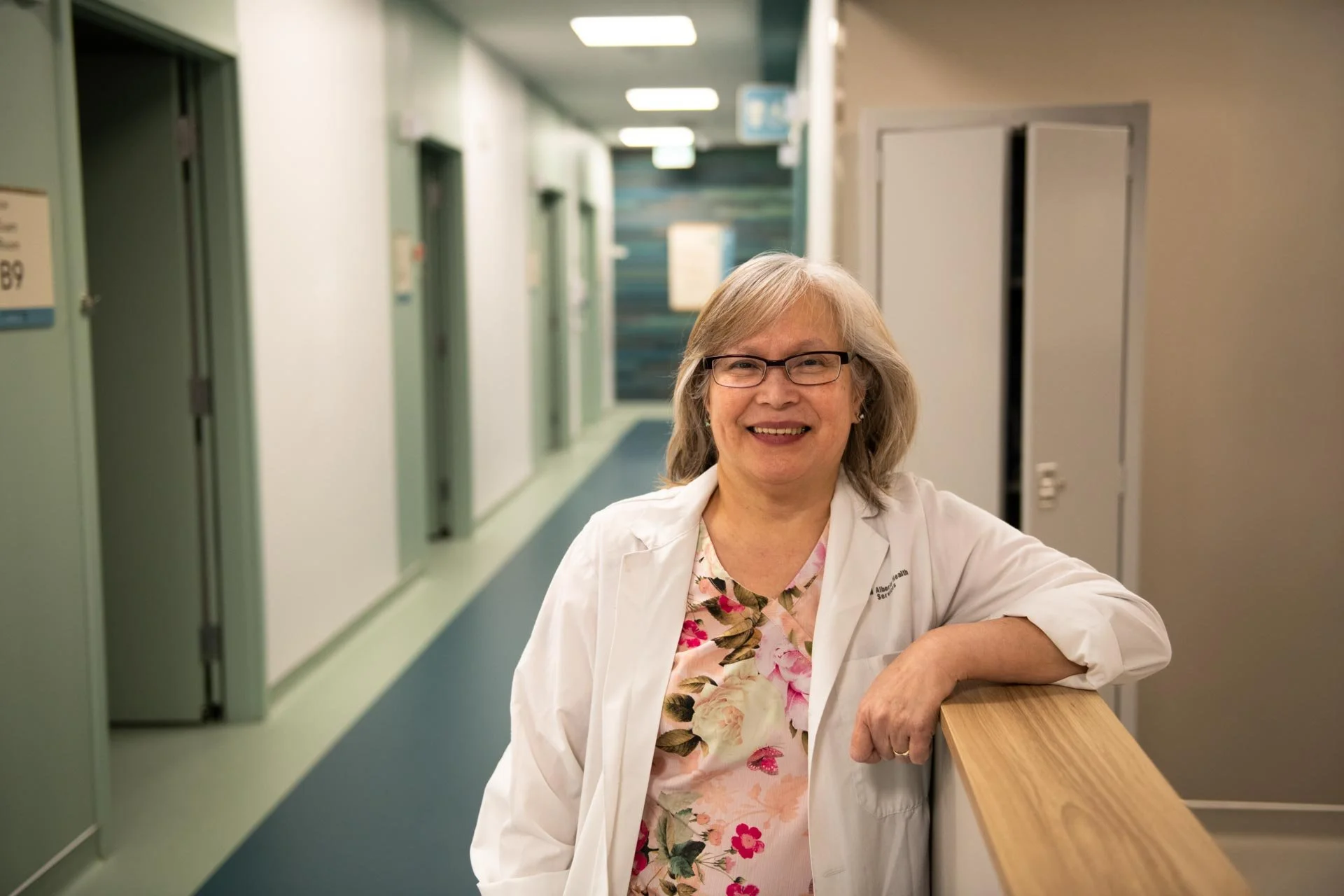
Three specialized clinics — ear, nose and throat (ENT), minor surgery and infectious diseases — at the Stelmach Community Health Centre in southeast Edmonton give patients access to procedures, consultations and followup care in a modern, community-based setting. Relocated from the Grey Nuns Community Hospital, these clinics now operate out of the outpatient clinic department at the new health centre.
ENT clinic
The ENT clinic sees patients who have a wide range of issues affecting the ears, nose and throat, says Eden Mopas, a registered nurse who has been with Covenant Health since 1988 and who is also the permanent charge nurse with the outpatient clinic department at the health centre.
Some patients may come to the ENT clinic because they’ve experienced sudden hearing loss. Others need ear debridement (i.e., cleaning) or have a growth in their nose, ear, mouth or throat that needs investigation. Patients with breathing difficulties caused by nasal blockages are also seen at the clinic as well as those who suffer from nose bleeds.
The clinic’s physicians often use an instrument called a laryngoscope to examine a patient's structures more closely, says Eden. Other procedures include ear tube insertions for patients with chronic ear issues.
The clinic also handles post-operative followups for patients who've had larger procedures in the operating room at the Grey Nuns hospital, such as septoplasty (nasal surgery) or ear surgery. Dr. Kal Ansari, one of the ENT physicians, performs reconstruction surgeries that often begin in the operating room at the hospital and are completed at the clinic during follow-up appointments. He also treats conditions like basal cell and squamous cell carcinoma and performs minor surgical procedures on-site when a full operating room isn't needed for the procedures.
Minor surgery clinic
The minor surgery clinic handles what Eden describes as "lumps and bumps." A patient might notice a small lump somewhere on their body, get referred to a surgeon for consultation and have it removed right at the clinic.
Most of the time it is a cyst, Eden says. It could also be a lipoma, which is like a fatty tissue that accumulates in some parts of the body. It's a very minor surgery that only needs local freezing, like the one a dentist uses, and then a small incision is made, just enough to enable the physician to remove the cyst or lipoma. The physician takes it out and sometimes sends it for biopsy or testing to the laboratory. At the end of the procedure, the incision is sutured, and a dressing is applied to the area. The patient usually goes home right after the procedure.
Gynecological procedures are also performed through the minor surgery clinic, including vulvar biopsies, endometrial biopsies, intrauterine device insertions and removals and Nexplanon implants — a form of birth control placed in the arm.
The clinic also sees patients with rectal issues such as hemorrhoids, which are often treated through a procedure called hemorrhoidal banding, as well as patients with thyroid issues. For those patients, one of the surgeons may perform a fine needle biopsy on the thyroid for lab testing.
Along with these procedures, the minor surgery clinic provides consultations for patients with conditions that may require colonoscopy, gastroscopy or gallbladder assessment. Many of these patients are initially seen in the emergency department at the Grey Nuns hospital and referred onward.
Infectious diseases clinic
The infectious diseases clinic serves patients with chronic or recurring infections that haven't responded to standard antibiotics. These might include persistent lung infections, recurring bladder or kidney infections or post-operative infections that aren't healing.
"These patients are referred to the infectious diseases clinic to get our specialist's expertise and opinions on how to best treat the specific infection," says Eden.
The clinic also sees patients with wounds that aren't healing despite antibiotic treatment. Most visits are followups, though some are initial consultations.
How patients are referred
All three specialty clinics operate on a referral basis only. Most of the referrals come from family doctors and from the emergency department at the Grey Nuns hospital, says Eden. Some also come through Alberta’s Facilitated Access to Specialized Treatment (FAST) program. The physicians at each clinic have their own offices with their own medical office assistants, who receive the referrals. The referrals are triaged according to urgency, and a list of patients is chosen to be seen at the health centre.
“Oftentimes, the decision is made to have patients seen in our clinics due to the fact that they need some type of procedure, although some are seen for just consultation and followups,” says Eden.
The teams
The ENT clinic typically runs with a physician, one or two residents (depending on the rotation), a nurse and a clinical assistant. The nurse assists the physician while the clinical assistant plays a hands-on role, helping manage specialized equipment like scopes that require careful handling.
The minor surgery and infectious diseases clinics each run with a physician and a nurse. Two to three clinical assistants are on duty most days and are assigned across clinics by the charge nurse based on where the need is greatest.
Clinic schedules
The three clinics operate at different times and days of the week. The ENT clinic runs one to two days per week, the minor surgery clinic operates two to three days per week and the infectious diseases clinic runs one to three days per week, depending on physician availability.
Specific days can shift from week to week, since the physicians sometimes get called or are scheduled to the operating room at the Grey Nuns hospital on short notice, says Eden.
More space and a healthy setting
Eden says one of the biggest advantages of being at the Stelmach Community Health Centre is space.
"In the last few years at our old site, it was a challenge. Oftentimes, we had to juggle rooms since we didn't have enough space to give to each clinic."
At the Stelmach Community Health Centre, that pressure is gone. Having more rooms means being able to see more patients, and the modern, clean facility has drawn positive feedback.
"Most of the patients like it," Eden says. "The comments I'm getting are really positive."
With a pharmacy, MIC Medical Imaging and other services already open at the health centre — and laboratory services on the way — patients can also take care of multiple needs in a single visit.
Moving these specialized clinics out of the hospital and into a community wellness centre also reduces patients' potential exposure to infections that may possibly be present in an acute care setting like a hospital — a practical benefit that Eden is quick to point out.
"It's nice to be going to a facility that is away from the hospital," she says. “The health centre is a very positive thing for the community and for our patients. They feel better coming here.”

Find your way with Covenant Map
With the Covenant Map app, explore everything the Stelmach Community Health Centre at Covenant Wellness Community has to offer.
Download on the App Store or Google Play.